





Irregular Army
“One of our finest investigative journalists illuminates the terrifying machinery of our ascendant authoritarian state. Essential.”
—Chris Hedges“A necessary corrective to patriotic bromides about the troops, and a bracing exposé of the declining quality of personnel serving in America’s all-volunteer army in an era of endless war.”
—Seth Harp“A powerful wake-up call. Time is running out.”
—Lawrence B. Wilkerson, former chief of staff to US secretary of State Colin Powell“Exposes the growth of extremist elements within the world’s most lethal killing machine . . . a warning cry.”
—Jeremy Scahill“Couldn’t be more urgent.”
—Huffington Post“Chilling . . . Kennard’s nonpartisan portrait of martial waywardness is foreboding.”
—Publishers Weekly“Kennard demonstrates a serious weakness in America’s ability to recruit a long- or even medium-term occupying force.”
—The American Conservative“A devastating critique of the recruitment policies of our major ally.”
—The Independent“Exposes both the roots of defective military recruitment and its deadly aftershocks . . . An urgent warning.”
—Daryl Johnson, former senior domestic terrorism analyst, Department of Homeland Security“Chilling in its prescience.”
—Spencer Ackerman“Required reading . . . a compelling explanation for the clear and present danger facing America.
—Thomas Drake, whistleblower and former executive, US National Security Agencyabout the bookabout
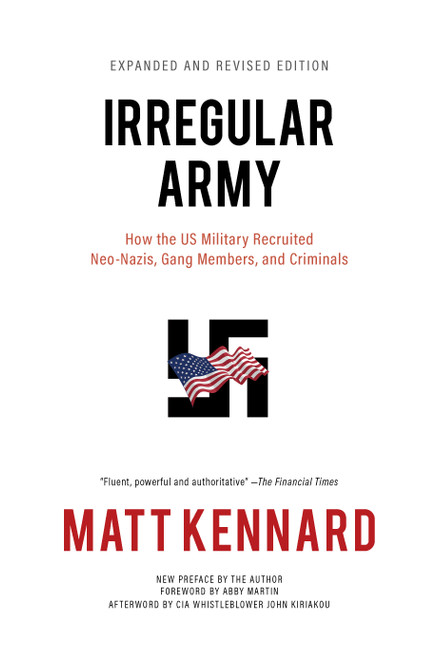
In Irregular Army, investigative journalist Matt Kennard delivers a searing exposé of how the US military’s recruitment crisis during the War on Terror opened the ranks to some of the most dangerous elements in American society: white supremacists, neo-Nazis, gang members, and convicted criminals. This updated edition deepens the original’s urgent warning, connecting those recruitment policies directly to the rise of MAGA extremism, Trumpism, and the global resurgence of fascism.
Drawing on years of on-the-ground reporting and interviews with extremist veterans and military insiders, Kennard reveals how the Pentagon knowingly empowered violent ideologues in its desperation to staff the wars in Afghanistan and Iraq. Now back on American soil―and in some cases in positions of power―many of these veterans see their mission continuing through race-war fantasies, far-right organizing, and criminal enterprises.
About The Author / Editor

Preview
My journey into the dark underworld of the US military begins on a rainy Tuesday morning, with a visit to Tampa, Florida, on the south-eastern tip of the country. The mission is simple: to meet Forrest Fogarty, a diehard American patriot who has served the US Army proudly for two years in Iraq, the central focus of America’s War on Terror and the country’s most controversial foreign adventure since Vietnam. The twist is that Forrest doubles as a white supremacist of the serious Hitler-worshipping type. Over the preceding months, I’d been speaking to him intermittently on his cell phone after his brother had put us in contact. It was a necessarily convoluted route: getting inside the neo-Nazi network in the United States is no cakewalk, requiring endless appeals via phone and email to penetrate the thick walls put up against a hostile mainstream media. I’d been uniquely successful with Fogarty, who is an effortlessly loquacious character with a compelling story, so I take a flight from New York City to meet him.
A couple of hours after arrival I’m in a cab headed for Forrest’s favorite hangout, the Winghouse Bar & Grill, which describes itself as “a casual sports-bar with delicious over-sized entrees.” I’d assumed the place was downtown, so it’s an unpleasant surprise when the taxi speeds along endless miles of pitch-black highway with the full moon barely lighting up the dense forests and thickets whizzing by. The situation is prime for a bit of macabre daydreaming: will I be jumped by a group of his mates, maybe even end up decapitated in the woods? Before too long we pull up at the sparkling Winghouse, located on a plain at the side of the highway, its bright lights a welcome interruption to the surrounding blackness. It’s an open-plan restaurant with a bar in the middle and a group of Tampa belles in low-cut tops taking orders. In our brief phone call I’d asked Forrest how I would recognize him. “Just look for the skinhead with the tattoos,” he said, laughing. And sure enough, sitting straight to my right as I walk in is a youngish looking man, plastered in tattoos, with tightly cropped hair, wife-beater vest, and bulging biceps—a poster-boy skinhead, the archetypal American Nazi.
Forrest is obviously in his element in the Winghouse as he slouches in his chair, beer in one hand, chicken wing in the other. He doesn’t take long to start in with his life story, which, for shock value, is admittedly hard to beat. He tells me he grew up in Los Angeles and moved to Tampa at fifteen with some serious psychological baggage. In high school in LA he was bullied by Mexican and African American children and was just fourteen when he decided he wanted to be a Nazi. By the time his family moved and he switched to Leto High in Tampa, he had found his identity: “I eventually got kicked out of Leto High, for being a racialist,” he says, his voice quivering with anger still. “I was getting in a few fights. What they do in desegregation is bus blacks into the neighborhood. On the first day, a bunch of niggers, they said ‘Are you in the KKK?’ to me, and I said, ‘Yeah,’ and it was on. After this, I kept getting in fights, eventually they expelled me.”
It’s nerve-wracking sitting in a bar with Forrest as he vents openly against black people and Jews. But there’s more to Forrest than just bravado. As he downs our pitcher of Bud he becomes freer and talks about his other great passion in life: music. As a young man he was obsessed with Ian Stuart Donaldson, the legendary singer in the British band Skrewdriver, who is hero-worshipped in the neo-Nazi music scene with a fervor akin to a thirteen-year-old Goth’s veneration of Marilyn Manson. This adulation was so strong that at sixteen Forrest had an image from one of Skrewdriver’s album covers—a Viking carrying an axe, an icon among white nationalists—tattooed on his left forearm. Soon after he had a Celtic cross, an Irish symbol appropriated by neo-Nazis, emblazoned on his stomach. A few years later he started his own band, Attack, now one of the biggest Nazi bands in the US, playing all over the country to crowds of white power fans. But it was never his day job. “I was a landscaper when I left school,” he says, leaning back in his chair. “I kind of fell into it, I was a kid back then. I didn’t give a shit what I was doing, I was just drinking and fighting.”
For the next eight years he drifted through jobs in construction and landscaping and began hanging out with the National Alliance, at the time one of the biggest neo-Nazi organizations in the US. He soon became a member. The group’s founder was the late William Pierce, author of The Turner Diaries, a novel describing the violent overthrow of the American government, and which is believed to have inspired Timothy McVeigh to carry out the 1995 terrorist attack in Oklahoma. The Alliance is one of the few durable fixtures in the American extremist firmament, where groups often start up and die within a hummingbird’s lifetime. At the time of Forrest’s involvement with them, they were arguably the most powerful far-right force in the US. It has called for “a long-term eugenics program involving at least the entire populations of Europe and America.”
With his music and friends in place, Forrest turned his attention to his lackluster work. Construction was never what he had wanted to do. He had always seen himself as a fighter and warrior. So he resolved to do what two generations of Fogartys had done before him: join the military. “I wanted to serve my country,” he says as he chews on the last remnants of chicken. “Every male part of my family has served in combat; my father was in Vietnam for two tours as part of the Marine Corps, and my grandfather was in World War Two, Korea and Vietnam.”
Forrest would not be the first extremist to enter the armed forces. The neo-Nazi movement has had a long and tense relationship with the US military, documented for decades. Since its inception, the leaders of the white supremacist movement—which is as old as the country—have encouraged their members to enlist. They see it as a way for their followers to receive combat and weapons training, courtesy of the US government, and to bring what they learn home to then undertake a domestic race war.
The presence of white supremacists in the military first triggered concern in 1976. At Camp Pendleton in California, a group of black marines attacked white marines they mistakenly believed to be in the KKK. The resulting investigation uncovered a KKK chapter at the base and led to the jailing or transfer of sixteen Klansmen. But the Vietnam-era legislation was the extent of provisions until 1986, when reports again surfaced of army and Marine Corps members participating in Ku Klux Klan activities. This forced President Reagan’s Secretary of Defense at the time, Caspar Weinberger, to issue a directive stipulating that “military personnel must reject participation in white supremacy, neo-Nazi, and other such groups which espouse or attempt to create overt discrimination.” The 1986 policy change was modified further in 1996 when language was added to the DOD Directive that specifically banned white supremacist and neo-Nazi groups. It explicitly “prohibited activities” by these groups in the military. This change came after the murder in 1995 of two African Americans by a neo-Nazi paratrooper stationed at Fort Bragg, North Carolina. The killings led to an investigation that ultimately revealed twenty-two soldiers at Fort Bragg with known extremist tendencies. Fogarty was recruited the year after.
As we finish up our drinks at the Winghouse, I ask if I can meet Forrest again while I’m in the city, which is for just another three days. “I’m working tomorrow, and with the kids on Saturday,” he says. Thinking quickly, I suggest taking them all to the local zoo, the first attraction I can remember from my hotel tourist pack. “Yeah, why not,” he says, and we set a date for Saturday afternoon.
in the media
Related Interest
Irregular Army
“One of our finest investigative journalists illuminates the terrifying machinery of our ascendant authoritarian state. Essential.”
—Chris Hedges“A necessary corrective to patriotic bromides about the troops, and a bracing exposé of the declining quality of personnel serving in America’s all-volunteer army in an era of endless war.”
—Seth Harp“A powerful wake-up call. Time is running out.”
—Lawrence B. Wilkerson, former chief of staff to US secretary of State Colin Powell“Exposes the growth of extremist elements within the world’s most lethal killing machine . . . a warning cry.”
—Jeremy Scahill“Couldn’t be more urgent.”
—Huffington Post“Chilling . . . Kennard’s nonpartisan portrait of martial waywardness is foreboding.”
—Publishers Weekly“Kennard demonstrates a serious weakness in America’s ability to recruit a long- or even medium-term occupying force.”
—The American Conservative“A devastating critique of the recruitment policies of our major ally.”
—The Independent“Exposes both the roots of defective military recruitment and its deadly aftershocks . . . An urgent warning.”
—Daryl Johnson, former senior domestic terrorism analyst, Department of Homeland Security“Chilling in its prescience.”
—Spencer Ackerman“Required reading . . . a compelling explanation for the clear and present danger facing America.
—Thomas Drake, whistleblower and former executive, US National Security Agencyabout the bookabout
In Irregular Army, investigative journalist Matt Kennard delivers a searing exposé of how the US military’s recruitment crisis during the War on Terror opened the ranks to some of the most dangerous elements in American society: white supremacists, neo-Nazis, gang members, and convicted criminals. This updated edition deepens the original’s urgent warning, connecting those recruitment policies directly to the rise of MAGA extremism, Trumpism, and the global resurgence of fascism.
Drawing on years of on-the-ground reporting and interviews with extremist veterans and military insiders, Kennard reveals how the Pentagon knowingly empowered violent ideologues in its desperation to staff the wars in Afghanistan and Iraq. Now back on American soil―and in some cases in positions of power―many of these veterans see their mission continuing through race-war fantasies, far-right organizing, and criminal enterprises.
About The Author / Editor
Preview
My journey into the dark underworld of the US military begins on a rainy Tuesday morning, with a visit to Tampa, Florida, on the south-eastern tip of the country. The mission is simple: to meet Forrest Fogarty, a diehard American patriot who has served the US Army proudly for two years in Iraq, the central focus of America’s War on Terror and the country’s most controversial foreign adventure since Vietnam. The twist is that Forrest doubles as a white supremacist of the serious Hitler-worshipping type. Over the preceding months, I’d been speaking to him intermittently on his cell phone after his brother had put us in contact. It was a necessarily convoluted route: getting inside the neo-Nazi network in the United States is no cakewalk, requiring endless appeals via phone and email to penetrate the thick walls put up against a hostile mainstream media. I’d been uniquely successful with Fogarty, who is an effortlessly loquacious character with a compelling story, so I take a flight from New York City to meet him.
A couple of hours after arrival I’m in a cab headed for Forrest’s favorite hangout, the Winghouse Bar & Grill, which describes itself as “a casual sports-bar with delicious over-sized entrees.” I’d assumed the place was downtown, so it’s an unpleasant surprise when the taxi speeds along endless miles of pitch-black highway with the full moon barely lighting up the dense forests and thickets whizzing by. The situation is prime for a bit of macabre daydreaming: will I be jumped by a group of his mates, maybe even end up decapitated in the woods? Before too long we pull up at the sparkling Winghouse, located on a plain at the side of the highway, its bright lights a welcome interruption to the surrounding blackness. It’s an open-plan restaurant with a bar in the middle and a group of Tampa belles in low-cut tops taking orders. In our brief phone call I’d asked Forrest how I would recognize him. “Just look for the skinhead with the tattoos,” he said, laughing. And sure enough, sitting straight to my right as I walk in is a youngish looking man, plastered in tattoos, with tightly cropped hair, wife-beater vest, and bulging biceps—a poster-boy skinhead, the archetypal American Nazi.
Forrest is obviously in his element in the Winghouse as he slouches in his chair, beer in one hand, chicken wing in the other. He doesn’t take long to start in with his life story, which, for shock value, is admittedly hard to beat. He tells me he grew up in Los Angeles and moved to Tampa at fifteen with some serious psychological baggage. In high school in LA he was bullied by Mexican and African American children and was just fourteen when he decided he wanted to be a Nazi. By the time his family moved and he switched to Leto High in Tampa, he had found his identity: “I eventually got kicked out of Leto High, for being a racialist,” he says, his voice quivering with anger still. “I was getting in a few fights. What they do in desegregation is bus blacks into the neighborhood. On the first day, a bunch of niggers, they said ‘Are you in the KKK?’ to me, and I said, ‘Yeah,’ and it was on. After this, I kept getting in fights, eventually they expelled me.”
It’s nerve-wracking sitting in a bar with Forrest as he vents openly against black people and Jews. But there’s more to Forrest than just bravado. As he downs our pitcher of Bud he becomes freer and talks about his other great passion in life: music. As a young man he was obsessed with Ian Stuart Donaldson, the legendary singer in the British band Skrewdriver, who is hero-worshipped in the neo-Nazi music scene with a fervor akin to a thirteen-year-old Goth’s veneration of Marilyn Manson. This adulation was so strong that at sixteen Forrest had an image from one of Skrewdriver’s album covers—a Viking carrying an axe, an icon among white nationalists—tattooed on his left forearm. Soon after he had a Celtic cross, an Irish symbol appropriated by neo-Nazis, emblazoned on his stomach. A few years later he started his own band, Attack, now one of the biggest Nazi bands in the US, playing all over the country to crowds of white power fans. But it was never his day job. “I was a landscaper when I left school,” he says, leaning back in his chair. “I kind of fell into it, I was a kid back then. I didn’t give a shit what I was doing, I was just drinking and fighting.”
For the next eight years he drifted through jobs in construction and landscaping and began hanging out with the National Alliance, at the time one of the biggest neo-Nazi organizations in the US. He soon became a member. The group’s founder was the late William Pierce, author of The Turner Diaries, a novel describing the violent overthrow of the American government, and which is believed to have inspired Timothy McVeigh to carry out the 1995 terrorist attack in Oklahoma. The Alliance is one of the few durable fixtures in the American extremist firmament, where groups often start up and die within a hummingbird’s lifetime. At the time of Forrest’s involvement with them, they were arguably the most powerful far-right force in the US. It has called for “a long-term eugenics program involving at least the entire populations of Europe and America.”
With his music and friends in place, Forrest turned his attention to his lackluster work. Construction was never what he had wanted to do. He had always seen himself as a fighter and warrior. So he resolved to do what two generations of Fogartys had done before him: join the military. “I wanted to serve my country,” he says as he chews on the last remnants of chicken. “Every male part of my family has served in combat; my father was in Vietnam for two tours as part of the Marine Corps, and my grandfather was in World War Two, Korea and Vietnam.”
Forrest would not be the first extremist to enter the armed forces. The neo-Nazi movement has had a long and tense relationship with the US military, documented for decades. Since its inception, the leaders of the white supremacist movement—which is as old as the country—have encouraged their members to enlist. They see it as a way for their followers to receive combat and weapons training, courtesy of the US government, and to bring what they learn home to then undertake a domestic race war.
The presence of white supremacists in the military first triggered concern in 1976. At Camp Pendleton in California, a group of black marines attacked white marines they mistakenly believed to be in the KKK. The resulting investigation uncovered a KKK chapter at the base and led to the jailing or transfer of sixteen Klansmen. But the Vietnam-era legislation was the extent of provisions until 1986, when reports again surfaced of army and Marine Corps members participating in Ku Klux Klan activities. This forced President Reagan’s Secretary of Defense at the time, Caspar Weinberger, to issue a directive stipulating that “military personnel must reject participation in white supremacy, neo-Nazi, and other such groups which espouse or attempt to create overt discrimination.” The 1986 policy change was modified further in 1996 when language was added to the DOD Directive that specifically banned white supremacist and neo-Nazi groups. It explicitly “prohibited activities” by these groups in the military. This change came after the murder in 1995 of two African Americans by a neo-Nazi paratrooper stationed at Fort Bragg, North Carolina. The killings led to an investigation that ultimately revealed twenty-two soldiers at Fort Bragg with known extremist tendencies. Fogarty was recruited the year after.
As we finish up our drinks at the Winghouse, I ask if I can meet Forrest again while I’m in the city, which is for just another three days. “I’m working tomorrow, and with the kids on Saturday,” he says. Thinking quickly, I suggest taking them all to the local zoo, the first attraction I can remember from my hotel tourist pack. “Yeah, why not,” he says, and we set a date for Saturday afternoon.