


Related Interest



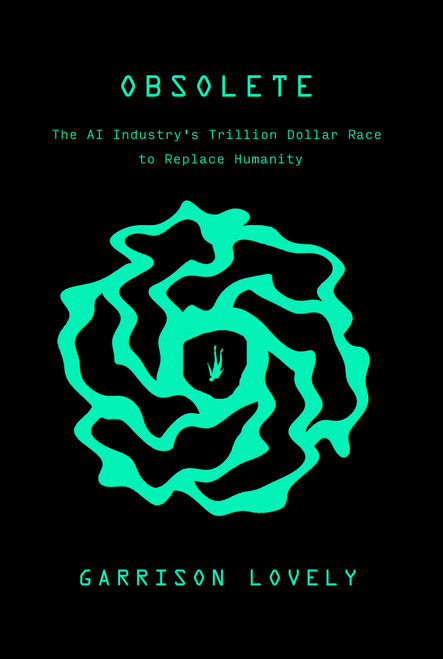
Obsolete
“The best book I’ve read on AI. It’s supremely timely, it takes no prisoners, and Sam Altman would hate it.”
—Luke Kempabout the bookabout
The biggest companies in history are racing to build a machine that replaces human labor—all of it. And, as this provocative new book insists, the only surefire way they won’t succeed is if we stop them.
Many today don’t get further than seeing AI as a boondoggle—a new shiny object for techno-capitalists to sink their cash into as we barrel toward climate disaster. Obsolete takes those concerns seriously, but implores us to keep our eye on the ball: A tiny group of people, backed by the richest companies in the world, is attempting to render you obsolete.
The scale of their project has no real precedent. What we think of as big—the Gilded Age monopolies, the Manhattan Project, the Apollo program—doesn’t even come close to capturing its size. Almost none of us want this vast transformation to succeed. Yet we're letting it proceed virtually unabated. Why? Because we don’t know it’s happening, we don’t believe it will work, or we don’t think we can stop it. Obsolete takes on all three.
AI expert and journalist Garrison Lovely's debut is a refreshing reset on an AI debate where basically everyone is getting some big things wrong. With deep access to top researchers, advocates, and industry insiders, Obsolete demonstrates how the technology will shape all of our futures—and why we can't afford to sit this one out.
About The Author / Editor

Preview
A tiny group of people, backed by the best-resourced organizations in the world, is attempting to render humanity obsolete. Not every participant in the project even believes this is possible, but the effort's vanguard has defined itself through its faith in the transformative potential of machine intelligence and its willingness to forge ahead despite the grave risks it so routinely acknowledges.
The industry’s ultimate goal and the most controversial term in this space—artificial general intelligence—conjures up images of a new type of mind that might think like our own. But it would not. And “AGI” keeps the focus on what it might be, when the attention should really be on what it might do. It would be better to understand what companies like OpenAI, Anthropic, and Google are trying to build not as a new type of brain, but rather a new type of machine, one that doesn’t make products or services, but produces labor itself.
Why? Humans—and human-derived labor—are messy. Humanity has always been constrained because humans are the constraint. It takes a long time to make more of us, to educate us, to feed and shelter us. We can only do so much. For centuries, automation has allowed owners to substitute some capital for labor—the tractor for the scythe, the loom for the needle—but only to a point.
Now, machine intelligence promises the potential to cut out that last constraint: us. This obliterates the one fundamental limit and opens up new worlds of possibility. Many of them, as we will see, are terrifying.
The leaders of what, in this book, I’ll call the Obsoleting Project may contest this framing, offering some bromides about how AI will augment human work or how we’ll simply find new jobs to do. But their stated goals are to create systems that so clearly surpass our abilities that we will have little hope of competing. OpenAI makes this explicit, defining AGI as “a highly autonomous system that outperforms humans at most economically valuable work.”
Many are skeptical that the Obsoleting Project will succeed. Perhaps you are too, and I don’t blame you. Often, seemingly equally credentialed people are making opposite claims about the present and future of the technology. But the Project’s scale has no real precedent. What we think of as big—Gilded Age monopolies, the Manhattan Project, the Apollo program—doesn’t even come close to capturing its size. It’s worth looking carefully at whether it has a chance of succeeding.
As with all new technologies, the Obsoleting Machine, if it works as intended, will create winners and losers. If you’d like to double down on today’s biggest winners—the ones developing it, the capital-owners, and the bosses, along with the nations and fortunes large enough to buy a seat at the table—then bring on the acceleration. The Obsoleting Project is, essentially, an inequality engine, aspirationally turning unfathomable amounts of capital into other people’s unemployment, all to maximize value for shareholders. The crowning irony: the Project was built on the backs of humanity’s collective labor, appropriated wholesale—our shared inheritance plundered to create private fortunes.
Understanding these dynamics—who wins, who loses, and why—is essential to grasping what's actually happening right now, and what might happen next. Other books have been written about machines that might one day think. This is the first book about machines that might one day make labor.
in the media
Related Interest
Related Interest
Obsolete
“The best book I’ve read on AI. It’s supremely timely, it takes no prisoners, and Sam Altman would hate it.”
—Luke Kempabout the bookabout
The biggest companies in history are racing to build a machine that replaces human labor—all of it. And, as this provocative new book insists, the only surefire way they won’t succeed is if we stop them.
Many today don’t get further than seeing AI as a boondoggle—a new shiny object for techno-capitalists to sink their cash into as we barrel toward climate disaster. Obsolete takes those concerns seriously, but implores us to keep our eye on the ball: A tiny group of people, backed by the richest companies in the world, is attempting to render you obsolete.
The scale of their project has no real precedent. What we think of as big—the Gilded Age monopolies, the Manhattan Project, the Apollo program—doesn’t even come close to capturing its size. Almost none of us want this vast transformation to succeed. Yet we're letting it proceed virtually unabated. Why? Because we don’t know it’s happening, we don’t believe it will work, or we don’t think we can stop it. Obsolete takes on all three.
AI expert and journalist Garrison Lovely's debut is a refreshing reset on an AI debate where basically everyone is getting some big things wrong. With deep access to top researchers, advocates, and industry insiders, Obsolete demonstrates how the technology will shape all of our futures—and why we can't afford to sit this one out.
About The Author / Editor
Preview
A tiny group of people, backed by the best-resourced organizations in the world, is attempting to render humanity obsolete. Not every participant in the project even believes this is possible, but the effort's vanguard has defined itself through its faith in the transformative potential of machine intelligence and its willingness to forge ahead despite the grave risks it so routinely acknowledges.
The industry’s ultimate goal and the most controversial term in this space—artificial general intelligence—conjures up images of a new type of mind that might think like our own. But it would not. And “AGI” keeps the focus on what it might be, when the attention should really be on what it might do. It would be better to understand what companies like OpenAI, Anthropic, and Google are trying to build not as a new type of brain, but rather a new type of machine, one that doesn’t make products or services, but produces labor itself.
Why? Humans—and human-derived labor—are messy. Humanity has always been constrained because humans are the constraint. It takes a long time to make more of us, to educate us, to feed and shelter us. We can only do so much. For centuries, automation has allowed owners to substitute some capital for labor—the tractor for the scythe, the loom for the needle—but only to a point.
Now, machine intelligence promises the potential to cut out that last constraint: us. This obliterates the one fundamental limit and opens up new worlds of possibility. Many of them, as we will see, are terrifying.
The leaders of what, in this book, I’ll call the Obsoleting Project may contest this framing, offering some bromides about how AI will augment human work or how we’ll simply find new jobs to do. But their stated goals are to create systems that so clearly surpass our abilities that we will have little hope of competing. OpenAI makes this explicit, defining AGI as “a highly autonomous system that outperforms humans at most economically valuable work.”
Many are skeptical that the Obsoleting Project will succeed. Perhaps you are too, and I don’t blame you. Often, seemingly equally credentialed people are making opposite claims about the present and future of the technology. But the Project’s scale has no real precedent. What we think of as big—Gilded Age monopolies, the Manhattan Project, the Apollo program—doesn’t even come close to capturing its size. It’s worth looking carefully at whether it has a chance of succeeding.
As with all new technologies, the Obsoleting Machine, if it works as intended, will create winners and losers. If you’d like to double down on today’s biggest winners—the ones developing it, the capital-owners, and the bosses, along with the nations and fortunes large enough to buy a seat at the table—then bring on the acceleration. The Obsoleting Project is, essentially, an inequality engine, aspirationally turning unfathomable amounts of capital into other people’s unemployment, all to maximize value for shareholders. The crowning irony: the Project was built on the backs of humanity’s collective labor, appropriated wholesale—our shared inheritance plundered to create private fortunes.
Understanding these dynamics—who wins, who loses, and why—is essential to grasping what's actually happening right now, and what might happen next. Other books have been written about machines that might one day think. This is the first book about machines that might one day make labor.