


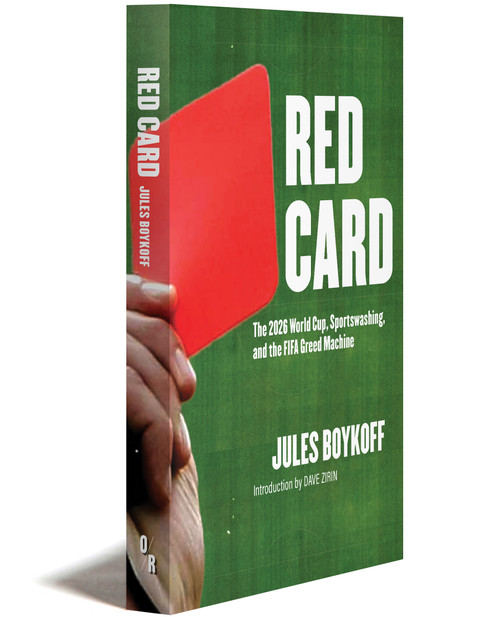


Red Card
“Very readable and well-informed.”
—Simon Kuper“An incisive, authoritative look at the state of the game in 2026...A sweeping history of sportswashing, authoritarianism, and greed...Red Card is also a clear-eyed, damning look at this tournament.”
—Alex Shephard“Rips off the band-aid that covers the noxious realpolitik of global football.”
—Christopher Gaffney“Jules Boykoff’s new book is indispensable reading for those who want to make sense of the gradual degeneration of international football and how to reclaim the beauty within the game.”
—Karim Zidan“There is no one better equipped than Boykoff to interrogate the FIFA World Cup...he critiques it with nuance, intelligence, and vigour...a must-read for anyone interested in football, transparency, and truth.”
—Shireen Ahmed“It is as erudite as it is earnest. Boykoff's searing criticism doesn't leave you feeling defeated, but rather, hopeful that we can breathe life back into football.”
—Brenda Elsey“A handy guide for anyone trying to make sense of just how the World Cup got to be such a mess...a snappy, engaging history of sports’ knotty entanglement with politics.”
—Jacobin“We urgently need writers and thinkers like Boykoff to encourage us to reclaim the people’s game for the communities it is supposed to serve.”
—Nick McGeehan“Essential reading for anyone who truly loves the beautiful game and believes in sport’s real values of integrity, inclusion, and human rights.”
—Andrea Florenceabout the bookabout
Publishing on the eve of the soccer World Cup in the United States, Mexico, and Canada, this concise, power-packed philippic provides a critical take on the dark underbelly of the beautiful game at its most storied moment.
At the heart of this analysis by acclaimed sportswriter and scholar Jules Boykoff, who himself played soccer professionally, is the concept of sportswashing, where political leaders use sports to stoke nationalism and legitimize themselves on the world stage, deflecting from chronic problems at home. Step forward the recipient of the newly cast FIFA Peace Prize, Donald J. Trump, a titan unrivaled in squeegeeing every drop of personal wealth and prestige from hosting the competition. In this, he is ably assisted by a governing body of global soccer dripping in patronage and corruption.
In these pages Boykoff demonstrates that it is possible to simultaneously treasure the skills and athleticism displayed on the pitch while lamenting their exploitation by malevolent powerbrokers for whom love of the game means nothing next to turning a buck or harvesting prestige. And, as Red Card so skillfully shows, this bait and switch is not confined to soccer. Precisely the same legerdemain will be used to distract and enrich when the Olympic Games come to Los Angeles two years from now.
About The Author / Editor
Preview
From the Introduction
Soccer is never just soccer. And sports are politics by other means.
This was abundantly clear when the powerbrokers of world football convened in December 2025 for the 2026 FIFA World Cup draw. Glitz and glam were in abundance. Supermodel Heidi Klum emceed the event alongside actor Kevin Hart. The audience included a Who’s Who of North American sports icons: NBA great Shaquille O’Neal, hockey Hall of Famer Wayne Gretzky, NFL Super Bowl champions Tom Brady, and New England Patriots owner—and Epstein files staple—Robert Kraft. The event featured the heads of state from all three host countries: Canadian Prime Minister Mark Carney, Mexican President Claudia Sheinbaum, and US President Donald Trump. To close the show, the Village People played its MAGA anthem “YMCA,” a brazen sop to Trump. The point of the event—sorting the 48 countries into twelve groups to compete in the World Cup—was relegated to a mere sideshow, lost amid the star-studded bromide-o-rama.
The event took place in Washington, DC, at the John F. Kennedy Center for the Performing Arts, renamed later that month “The Donald J. Trump and The John F. Kennedy Memorial Center for the Performing Arts” before being shut down when numerous artists refused to perform there. FIFA relocated the event from Las Vegas to make it as convenient as possible for Trump to attend. The switch was orchestrated by FIFA President Gianni Infantino, a man who had long made a tactical habit of sucking up to the powerful.
Infantino took his sycophancy to the next level at the 2026 World Cup draw, awarding Trump with the inaugural FIFA Peace Prize, a wholly confected accolade with no precedent, let alone serious criteria. The award—technically titled “FIFA Peace Prize – Football Unites the World”—was concocted the previous month “to reward individuals who have taken exceptional and extraordinary actions for peace and by doing so have united people across the world.” Infantino’s unilateral decision to establish the award blindsided his colleagues at the FIFA Council, composed of eight vice-presidents, 28 members at large, and chaired by Infantino himself. Some FIFA Council members first heard about the prize by reading a press release. When Human Rights Watch wrote to FIFA to request basic information about the prize—its search criteria, the nomination process, the judges for the award—the group was unceremoniously stonewalled.
The design of the trophy itself was downright bizarre: a gaudy assemblage of thin, grizzled hands that looked as if they were surfacing from the bowels of hell, stretching toward a golden orb hovering above. Infantino, who vocally supported Trump’s failed bid to win the Nobel Peace Prize, which instead went to Venezuela’s right-wing opposition leader María Corina Machado, took to the stage to explain why he chose Trump for the award: “This is what we want from a leader, a leader that cares about the people. We want to live in a safe world, in a safe environment. We want to unite. That’s what we do here today. That’s what we do at the World Cup, Mr. President, and you definitely deserve the first FIFA Peace Prize for your action, for what you have obtained in your way, but you obtained it in an incredible way.” Infantino went on to gush, “You can always count, Mr. President, on my support, on the support of the entire football community, or soccer community, to help you make peace and make the world prosper all over the world.”
Because Trump is a megalomaniac with a crude, transactional governing style and zero commitment to truth, he is well-situated to leverage the toxic gangsterism of sports. “The truth is that sport, in its current hyper-politicized and hyper-commodified form, is exquisitely suited to Trump’s needs,” wrote Bryan Armen Graham in the Guardian. “It supplies the crowds, the cameras, the ritual patriotism and the ready-made mythologies of strength and struggle. It gives him stadiums and arenas that can be turned into instant rallies and backstage corridors that double as donor gatherings.” In addition, Graham notes, “It offers him a role he prefers to the one described in the constitution: not head of the executive branch, but ringmaster-in-chief.”
Infantino has been Trump’s primary enabler when it comes to converting soccer into political advantage. He has visited the White House and Mar-a-Lago more than any world leader, so many times that Trump might start charging him rent. In fact, after Infantino established a New York headquarters in Trump Towers, he actually is paying rent to Trump. Gianni Infantino is Trump’s principal accomplice when it comes to sportswashing.
★ ★ ★
Sportswashing is when political leaders use sports to appear important or legitimate on the world stage while stoking nationalism and deflecting attention from chronic social problems and human-rights woes at home. Sportswashers use sports to try to burnish national prestige, to convey economic or political success, to spur personal enrichment. Sportswashing fortifies the bones of global capitalism while reconfiguring the meaning of fandom, allegiance, and human rights. It targets both domestic and international audiences. It has significant material implications, facilitating what David Harvey calls a “spatial fix”—moving surplus capital elsewhere and making it productive while diversifying a country’s investment portfolio. Beyond the money shuffle, sportswashing also plays a vital role in global discourse, subtly massaging reputational repair into public consciousness through the passion and popularity of sport. Importantly, sportswashing can also pave a path for war.
The global sports industry is big money, no question about it. It rakes in at least $2.655 trillion annually, placing it among the top ten revenue-producing industries globally; the United States makes up 40 percent of that total. Sports ownership and rights-holding go hand in hand with astronomical plutocracy. The largest private landowner in the United States is Stan Kroenke, the billionaire whose holding company owns Arsenal in the Premier League, Arsenal Women of the Women’s Super League, the Colorado Rapids of Major League Soccer, the NFL’s Los Angeles Rams, the NBA’s Denver Nuggets, the NHL’s Colorado Avalanche, and other sports teams.
And sports are enormously popular. One estimate found that 95 percent of the global population recognized the Olympic rings. The FIFA World Cup is the most-watched sports event on Earth. An estimated 1.5 billion people tuned in for the 2022 World Cup final between Argentina and France, while some 5 billion tuned in at some point during the tournament. The 2026 World Cup, with the field increased to 48 teams, promises to shatter these records.
in the media

Related Interest
Related Interest
Red Card
“Very readable and well-informed.”
—Simon Kuper“An incisive, authoritative look at the state of the game in 2026...A sweeping history of sportswashing, authoritarianism, and greed...Red Card is also a clear-eyed, damning look at this tournament.”
—Alex Shephard“Rips off the band-aid that covers the noxious realpolitik of global football.”
—Christopher Gaffney“Jules Boykoff’s new book is indispensable reading for those who want to make sense of the gradual degeneration of international football and how to reclaim the beauty within the game.”
—Karim Zidan“There is no one better equipped than Boykoff to interrogate the FIFA World Cup...he critiques it with nuance, intelligence, and vigour...a must-read for anyone interested in football, transparency, and truth.”
—Shireen Ahmed“It is as erudite as it is earnest. Boykoff's searing criticism doesn't leave you feeling defeated, but rather, hopeful that we can breathe life back into football.”
—Brenda Elsey“A handy guide for anyone trying to make sense of just how the World Cup got to be such a mess...a snappy, engaging history of sports’ knotty entanglement with politics.”
—Jacobin“We urgently need writers and thinkers like Boykoff to encourage us to reclaim the people’s game for the communities it is supposed to serve.”
—Nick McGeehan“Essential reading for anyone who truly loves the beautiful game and believes in sport’s real values of integrity, inclusion, and human rights.”
—Andrea Florenceabout the bookabout
Publishing on the eve of the soccer World Cup in the United States, Mexico, and Canada, this concise, power-packed philippic provides a critical take on the dark underbelly of the beautiful game at its most storied moment.
At the heart of this analysis by acclaimed sportswriter and scholar Jules Boykoff, who himself played soccer professionally, is the concept of sportswashing, where political leaders use sports to stoke nationalism and legitimize themselves on the world stage, deflecting from chronic problems at home. Step forward the recipient of the newly cast FIFA Peace Prize, Donald J. Trump, a titan unrivaled in squeegeeing every drop of personal wealth and prestige from hosting the competition. In this, he is ably assisted by a governing body of global soccer dripping in patronage and corruption.
In these pages Boykoff demonstrates that it is possible to simultaneously treasure the skills and athleticism displayed on the pitch while lamenting their exploitation by malevolent powerbrokers for whom love of the game means nothing next to turning a buck or harvesting prestige. And, as Red Card so skillfully shows, this bait and switch is not confined to soccer. Precisely the same legerdemain will be used to distract and enrich when the Olympic Games come to Los Angeles two years from now.
About The Author / Editor
Preview
From the Introduction
Soccer is never just soccer. And sports are politics by other means.
This was abundantly clear when the powerbrokers of world football convened in December 2025 for the 2026 FIFA World Cup draw. Glitz and glam were in abundance. Supermodel Heidi Klum emceed the event alongside actor Kevin Hart. The audience included a Who’s Who of North American sports icons: NBA great Shaquille O’Neal, hockey Hall of Famer Wayne Gretzky, NFL Super Bowl champions Tom Brady, and New England Patriots owner—and Epstein files staple—Robert Kraft. The event featured the heads of state from all three host countries: Canadian Prime Minister Mark Carney, Mexican President Claudia Sheinbaum, and US President Donald Trump. To close the show, the Village People played its MAGA anthem “YMCA,” a brazen sop to Trump. The point of the event—sorting the 48 countries into twelve groups to compete in the World Cup—was relegated to a mere sideshow, lost amid the star-studded bromide-o-rama.
The event took place in Washington, DC, at the John F. Kennedy Center for the Performing Arts, renamed later that month “The Donald J. Trump and The John F. Kennedy Memorial Center for the Performing Arts” before being shut down when numerous artists refused to perform there. FIFA relocated the event from Las Vegas to make it as convenient as possible for Trump to attend. The switch was orchestrated by FIFA President Gianni Infantino, a man who had long made a tactical habit of sucking up to the powerful.
Infantino took his sycophancy to the next level at the 2026 World Cup draw, awarding Trump with the inaugural FIFA Peace Prize, a wholly confected accolade with no precedent, let alone serious criteria. The award—technically titled “FIFA Peace Prize – Football Unites the World”—was concocted the previous month “to reward individuals who have taken exceptional and extraordinary actions for peace and by doing so have united people across the world.” Infantino’s unilateral decision to establish the award blindsided his colleagues at the FIFA Council, composed of eight vice-presidents, 28 members at large, and chaired by Infantino himself. Some FIFA Council members first heard about the prize by reading a press release. When Human Rights Watch wrote to FIFA to request basic information about the prize—its search criteria, the nomination process, the judges for the award—the group was unceremoniously stonewalled.
The design of the trophy itself was downright bizarre: a gaudy assemblage of thin, grizzled hands that looked as if they were surfacing from the bowels of hell, stretching toward a golden orb hovering above. Infantino, who vocally supported Trump’s failed bid to win the Nobel Peace Prize, which instead went to Venezuela’s right-wing opposition leader María Corina Machado, took to the stage to explain why he chose Trump for the award: “This is what we want from a leader, a leader that cares about the people. We want to live in a safe world, in a safe environment. We want to unite. That’s what we do here today. That’s what we do at the World Cup, Mr. President, and you definitely deserve the first FIFA Peace Prize for your action, for what you have obtained in your way, but you obtained it in an incredible way.” Infantino went on to gush, “You can always count, Mr. President, on my support, on the support of the entire football community, or soccer community, to help you make peace and make the world prosper all over the world.”
Because Trump is a megalomaniac with a crude, transactional governing style and zero commitment to truth, he is well-situated to leverage the toxic gangsterism of sports. “The truth is that sport, in its current hyper-politicized and hyper-commodified form, is exquisitely suited to Trump’s needs,” wrote Bryan Armen Graham in the Guardian. “It supplies the crowds, the cameras, the ritual patriotism and the ready-made mythologies of strength and struggle. It gives him stadiums and arenas that can be turned into instant rallies and backstage corridors that double as donor gatherings.” In addition, Graham notes, “It offers him a role he prefers to the one described in the constitution: not head of the executive branch, but ringmaster-in-chief.”
Infantino has been Trump’s primary enabler when it comes to converting soccer into political advantage. He has visited the White House and Mar-a-Lago more than any world leader, so many times that Trump might start charging him rent. In fact, after Infantino established a New York headquarters in Trump Towers, he actually is paying rent to Trump. Gianni Infantino is Trump’s principal accomplice when it comes to sportswashing.
★ ★ ★
Sportswashing is when political leaders use sports to appear important or legitimate on the world stage while stoking nationalism and deflecting attention from chronic social problems and human-rights woes at home. Sportswashers use sports to try to burnish national prestige, to convey economic or political success, to spur personal enrichment. Sportswashing fortifies the bones of global capitalism while reconfiguring the meaning of fandom, allegiance, and human rights. It targets both domestic and international audiences. It has significant material implications, facilitating what David Harvey calls a “spatial fix”—moving surplus capital elsewhere and making it productive while diversifying a country’s investment portfolio. Beyond the money shuffle, sportswashing also plays a vital role in global discourse, subtly massaging reputational repair into public consciousness through the passion and popularity of sport. Importantly, sportswashing can also pave a path for war.
The global sports industry is big money, no question about it. It rakes in at least $2.655 trillion annually, placing it among the top ten revenue-producing industries globally; the United States makes up 40 percent of that total. Sports ownership and rights-holding go hand in hand with astronomical plutocracy. The largest private landowner in the United States is Stan Kroenke, the billionaire whose holding company owns Arsenal in the Premier League, Arsenal Women of the Women’s Super League, the Colorado Rapids of Major League Soccer, the NFL’s Los Angeles Rams, the NBA’s Denver Nuggets, the NHL’s Colorado Avalanche, and other sports teams.
And sports are enormously popular. One estimate found that 95 percent of the global population recognized the Olympic rings. The FIFA World Cup is the most-watched sports event on Earth. An estimated 1.5 billion people tuned in for the 2022 World Cup final between Argentina and France, while some 5 billion tuned in at some point during the tournament. The 2026 World Cup, with the field increased to 48 teams, promises to shatter these records.