



Related Interest




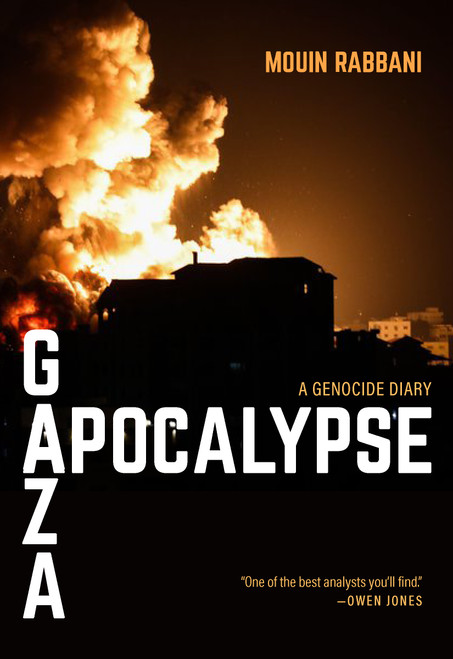
Gaza Apocalypse
“If you want to understand what’s actually happening, you should be reading Mouin Rabbani.”
—Daniel Denvir“Always wise, thoughtful, and morally clear.”
—Nathan Robinson“One of the best analysts you’ll find.”
—Owen Jonesabout the bookabout
Experts seeking insight on the Middle East have long turned to Mouin Rabbani, whose decades as a researcher and political analyst have included positions at the Palestinian human rights group Al Haq, the International Crisis Group, and the United Nations.
Since October 2023, Rabbani has attracted a global public following as a go-to guide to Israel's destruction of Gaza and the cascading regional chaos. Whether parsing breaking news, elucidating deeper dynamics, or dispatching apologists for US and Israeli aggression, Rabbani brings rich historical perspective and a refined political judgment—all expressed in his unflappable demeanour through muscular prose and with mordant wit.
Gaza Apocalypse presents Rabbani's real-time commentaries on the Gaza genocide as it unfolded. It is a record of expertise in action, as a leading Palestinian intellectual intervenes assiduously to make sense of, and inform the global movement against, an epochal catastrophe and crime.
About The Author / Editor

Preview
“Palestine is a little country. But what is being done in Palestine is symptomatic of the entire state of the world. It is the methods of settlement being used in Palestine, rather than the particular settlement which may be reached, to which I wish to direct attention. These methods, I will try to show, are disastrous; and if we persist in using them elsewhere in the world—and there is every indication that we shall—the result can only be violence and war.”
These are not my words, but rather those of Walter Terence Stace. And they were not written last week or last year, but in February 1947.
Stace, a former British colonial official who served in Ceylon, today Sri Lanka, was at the time he wrote these words attached to Princeton University’s Department of Philosophy. His article was published in the US magazine The Atlantic, during an era when its editor was not a former Israeli prison guard, and serious commentary on the Middle East was still an option.
In his article, Stace made short shrift of the Zionist movement’s claims to sovereignty in Palestine; argued that its policy of colonization and its drive for statehood, violating the principle of self-determination of the existing population, constituted the primary aggression producing conflict; dismantled the justifications for British and US support for Zionism; and concluded with the following warning:
“This is the real lesson of Palestine. It is not an isolated issue. It touches the future of the whole world. Just as Guernica was a good testing ground for German and Italian methods of war, so Palestine is the testing ground of our peace policies. Our methods there, our whole emotional and irrational approach to the problem, expose the hollowness and futility of our protestations about peace.”
Several months later the United Nations would ignore Stace’s warnings, adopt General Assembly Resolution 181 recommending the partition of Palestine, and set in motion the violence and war that has resulted ever since.
*
It is important to recognize that the Gaza Strip is of fairly recent provenance. Gaza City is of course among the very oldest cities on earth, and others such as Khan Yunis to its south also have a storied history.
But if you had consulted a map in 1945 in search of the Gaza Strip it would have been nowhere to be found. If you had asked a British official where it was to be found you would have received a bemused stare, and perhaps an admonition that the authorities did not tolerate such clubs.
This is because the Gaza Strip is a direct product of the Nakba of the late 1940s and early 1950s, during which more than 75 percent of the Arab population of the territory that became the state of Israel was forced out and, crucially, thereafter prevented from returning to their homes.
The Gaza Strip constituted that 1 percent of Mandatory Palestine located in its extreme southwest, abutting Egypt and the Mediterranean Sea, that did not come under Israeli rule. It is in fact also but a small portion of what was previously known as the Gaza District.
As a result of the Nakba, the territory’s native population of some eighty thousand increased by approximately two hundred thousand destitute and desperate refugees. In other words, the population of this vastly reduced territory more than tripled almost overnight. Conditions were not so very different from those we are familiar with today, and Palestinians as well as relief workers present at the time, such as the Quakers and International Red Cross, have written movingly about the conditions at that time.
Virtually from the outset, Israel adopted two policies: an absolute refusal to permit the refugees to return to their homes and villages. And, commencing shortly afterwards, promoting initiatives to drive the refugee population of the Gaza Strip further away from Israel’s boundaries.
Most of these refugees had come from southern Palestine, often on foot, and essentially lived within spitting distance of their former homes. Israel correctly feared their irredentist potential, and the Gaza Strip was in fact a primary incubator, more than Jerusalem, Nablus, Cairo, Amman, Damascus, or even Beirut, of the contemporary Palestinian national movement.
Throughout the 1950s and 1960s Israel advanced schemes to, in its vocabulary, “thin out” the population of the Gaza Strip, and of its eight refugee camps in particular, and transfer them to Libya, to Iraq, and elsewhere. After the second Israeli occupation of the Gaza Strip commenced in 1967 Israel also began implementing schemes to remove them to Jordan, to the occupied Sinai Peninsula and West Bank, and even to Paraguay in a deal struck by Israel with that country’s Nazi-friendly regime.
As the leading scholar of the Gaza Strip, Sara Roy of Harvard University has written, after 1967 Israel also pursued a policy of “de-development” towards the Gaza Strip. De-development, as distinct from under-development, is the deliberate, systematic dismantling of an economy and its potential in order to ensure it cannot develop in future. Simply put: to make the territory unfit for human habitation and thereby ensure its residents are left with no option but to leave. Those of you who visited the Gaza Strip prior to the establishment of the Palestinian Authority in 1994 will recognize that Roy knows whereof she speaks.
After the 2000 Camp David summit clarified that a genuinely sovereign Palestinian state on 22 percent of Mandatory Palestine was not on the US-Israeli agenda, and the West Bank and Gaza Strip once again erupted in rebellion, Israel dispensed with even the charade of Oslo’s permanent status negotiations. With only the briefest of interludes, it reverted to unilateralism as its preferred approach. Henceforth, issues in dispute with the Palestinians would be resolved by it and it alone, through the application of naked force and power, on terms determined solely by Israel’s strategic objectives. This was particularly evident in the Gaza Strip, where under Ariel Sharon Israel categorically refused to coordinate its 2005 “disengagement” with the Palestinian Authority. It did so in the full expectation that the territory would come to be dominated by Hamas, furthering Israel’s goal of Palestinian fragmentation.
Once Hamas did seize power in 2007, this served as a pretext for tightening its punishing blockade and for periodic military campaigns (termed “mowing the lawn” by Israeli planners) to keep Gaza weak, isolated, and permanently off balance. As multiple crises enveloped the region in 2011–12 the Palestinians all but disappeared from the regional and international agenda, reappearing if at all as window dressing for US-engineered Arab-Israeli normalization agreements designed not to promote a resolution of the Question of Palestine, but to further marginalize the Palestinians and leave them permanently at Israel’s mercy.
It is against this background that we should understand Hamas’s determination on 7 October to irrevocably shatter the status quo.
The ambition to depopulate the Gaza Strip had never quite disappeared, but beginning with the 1979 Egyptian-Israeli peace treaty was not pursued as a priority or even seriously because it was deemed impractical. Seen as a fantasy of Israel’s extreme right, it also never disappeared.
And in October 2023 it came back with a vengeance.
in the media
Related Interest
Related Interest
Gaza Apocalypse
“If you want to understand what’s actually happening, you should be reading Mouin Rabbani.”
—Daniel Denvir“Always wise, thoughtful, and morally clear.”
—Nathan Robinson“One of the best analysts you’ll find.”
—Owen Jonesabout the bookabout
Experts seeking insight on the Middle East have long turned to Mouin Rabbani, whose decades as a researcher and political analyst have included positions at the Palestinian human rights group Al Haq, the International Crisis Group, and the United Nations.
Since October 2023, Rabbani has attracted a global public following as a go-to guide to Israel's destruction of Gaza and the cascading regional chaos. Whether parsing breaking news, elucidating deeper dynamics, or dispatching apologists for US and Israeli aggression, Rabbani brings rich historical perspective and a refined political judgment—all expressed in his unflappable demeanour through muscular prose and with mordant wit.
Gaza Apocalypse presents Rabbani's real-time commentaries on the Gaza genocide as it unfolded. It is a record of expertise in action, as a leading Palestinian intellectual intervenes assiduously to make sense of, and inform the global movement against, an epochal catastrophe and crime.
About The Author / Editor
Preview
“Palestine is a little country. But what is being done in Palestine is symptomatic of the entire state of the world. It is the methods of settlement being used in Palestine, rather than the particular settlement which may be reached, to which I wish to direct attention. These methods, I will try to show, are disastrous; and if we persist in using them elsewhere in the world—and there is every indication that we shall—the result can only be violence and war.”
These are not my words, but rather those of Walter Terence Stace. And they were not written last week or last year, but in February 1947.
Stace, a former British colonial official who served in Ceylon, today Sri Lanka, was at the time he wrote these words attached to Princeton University’s Department of Philosophy. His article was published in the US magazine The Atlantic, during an era when its editor was not a former Israeli prison guard, and serious commentary on the Middle East was still an option.
In his article, Stace made short shrift of the Zionist movement’s claims to sovereignty in Palestine; argued that its policy of colonization and its drive for statehood, violating the principle of self-determination of the existing population, constituted the primary aggression producing conflict; dismantled the justifications for British and US support for Zionism; and concluded with the following warning:
“This is the real lesson of Palestine. It is not an isolated issue. It touches the future of the whole world. Just as Guernica was a good testing ground for German and Italian methods of war, so Palestine is the testing ground of our peace policies. Our methods there, our whole emotional and irrational approach to the problem, expose the hollowness and futility of our protestations about peace.”
Several months later the United Nations would ignore Stace’s warnings, adopt General Assembly Resolution 181 recommending the partition of Palestine, and set in motion the violence and war that has resulted ever since.
*
It is important to recognize that the Gaza Strip is of fairly recent provenance. Gaza City is of course among the very oldest cities on earth, and others such as Khan Yunis to its south also have a storied history.
But if you had consulted a map in 1945 in search of the Gaza Strip it would have been nowhere to be found. If you had asked a British official where it was to be found you would have received a bemused stare, and perhaps an admonition that the authorities did not tolerate such clubs.
This is because the Gaza Strip is a direct product of the Nakba of the late 1940s and early 1950s, during which more than 75 percent of the Arab population of the territory that became the state of Israel was forced out and, crucially, thereafter prevented from returning to their homes.
The Gaza Strip constituted that 1 percent of Mandatory Palestine located in its extreme southwest, abutting Egypt and the Mediterranean Sea, that did not come under Israeli rule. It is in fact also but a small portion of what was previously known as the Gaza District.
As a result of the Nakba, the territory’s native population of some eighty thousand increased by approximately two hundred thousand destitute and desperate refugees. In other words, the population of this vastly reduced territory more than tripled almost overnight. Conditions were not so very different from those we are familiar with today, and Palestinians as well as relief workers present at the time, such as the Quakers and International Red Cross, have written movingly about the conditions at that time.
Virtually from the outset, Israel adopted two policies: an absolute refusal to permit the refugees to return to their homes and villages. And, commencing shortly afterwards, promoting initiatives to drive the refugee population of the Gaza Strip further away from Israel’s boundaries.
Most of these refugees had come from southern Palestine, often on foot, and essentially lived within spitting distance of their former homes. Israel correctly feared their irredentist potential, and the Gaza Strip was in fact a primary incubator, more than Jerusalem, Nablus, Cairo, Amman, Damascus, or even Beirut, of the contemporary Palestinian national movement.
Throughout the 1950s and 1960s Israel advanced schemes to, in its vocabulary, “thin out” the population of the Gaza Strip, and of its eight refugee camps in particular, and transfer them to Libya, to Iraq, and elsewhere. After the second Israeli occupation of the Gaza Strip commenced in 1967 Israel also began implementing schemes to remove them to Jordan, to the occupied Sinai Peninsula and West Bank, and even to Paraguay in a deal struck by Israel with that country’s Nazi-friendly regime.
As the leading scholar of the Gaza Strip, Sara Roy of Harvard University has written, after 1967 Israel also pursued a policy of “de-development” towards the Gaza Strip. De-development, as distinct from under-development, is the deliberate, systematic dismantling of an economy and its potential in order to ensure it cannot develop in future. Simply put: to make the territory unfit for human habitation and thereby ensure its residents are left with no option but to leave. Those of you who visited the Gaza Strip prior to the establishment of the Palestinian Authority in 1994 will recognize that Roy knows whereof she speaks.
After the 2000 Camp David summit clarified that a genuinely sovereign Palestinian state on 22 percent of Mandatory Palestine was not on the US-Israeli agenda, and the West Bank and Gaza Strip once again erupted in rebellion, Israel dispensed with even the charade of Oslo’s permanent status negotiations. With only the briefest of interludes, it reverted to unilateralism as its preferred approach. Henceforth, issues in dispute with the Palestinians would be resolved by it and it alone, through the application of naked force and power, on terms determined solely by Israel’s strategic objectives. This was particularly evident in the Gaza Strip, where under Ariel Sharon Israel categorically refused to coordinate its 2005 “disengagement” with the Palestinian Authority. It did so in the full expectation that the territory would come to be dominated by Hamas, furthering Israel’s goal of Palestinian fragmentation.
Once Hamas did seize power in 2007, this served as a pretext for tightening its punishing blockade and for periodic military campaigns (termed “mowing the lawn” by Israeli planners) to keep Gaza weak, isolated, and permanently off balance. As multiple crises enveloped the region in 2011–12 the Palestinians all but disappeared from the regional and international agenda, reappearing if at all as window dressing for US-engineered Arab-Israeli normalization agreements designed not to promote a resolution of the Question of Palestine, but to further marginalize the Palestinians and leave them permanently at Israel’s mercy.
It is against this background that we should understand Hamas’s determination on 7 October to irrevocably shatter the status quo.
The ambition to depopulate the Gaza Strip had never quite disappeared, but beginning with the 1979 Egyptian-Israeli peace treaty was not pursued as a priority or even seriously because it was deemed impractical. Seen as a fantasy of Israel’s extreme right, it also never disappeared.
And in October 2023 it came back with a vengeance.