


Related Interest



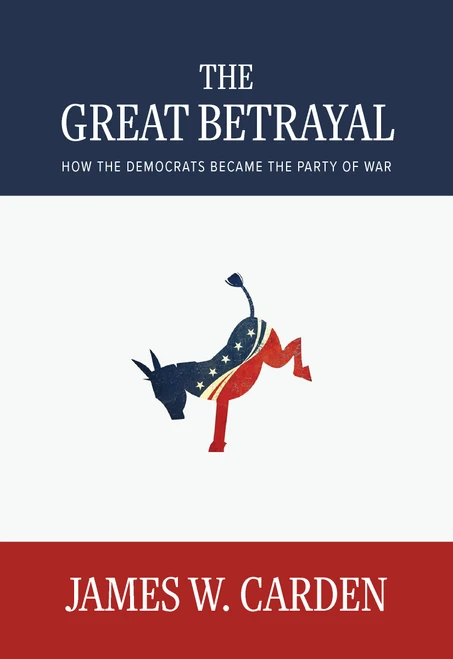
The Great Betrayal
“An outstanding study of US foreign policy, based on meticulous research. Its anti-interventionist argument will resonate.”
—David N. Gibbs“Brilliantly traces how the Democratic Party divested of the vision of international order that Roosevelt had once articulated, leaving the American people sick and tired of costly military interventions.”
—David Hendrickson“Carden’s clear, easy-to-read, and incisive analysis reveals how the imperial hubris of Achesonian Democrats betrayed Rooseveltian ideals of concerted global governance.”
—Hall Gardner“It’s the book we have been waiting for, explaining one of the great conundrums of contemporary international politics. A brilliant, timely, and important achievement.”
—Richard Sakwa“A brilliant analysis! Should be read by anyone who wants to understand how the U.S. failed to preserve peace in the world following the end of the Cold War.”
—Jack F. Matlock, Jr.about the bookabout
There was a time when the Democratic Party, under the leadership of FDR, was seen as shunning belligerence in foreign affairs, emphasizing instead international co-operation and respect for sovereign rights. In this it contrasted starkly with an aggressive Republican Party that rarely found a war it didn't like.
In subsequent decades, however, this characterization changed sharply. Whilst increasing numbers of Republicans moved to an isolationist position, a battle amongst the Democrats saw those who believed in the pluralistic and cooperative principles enshrined in the UN Charter increasingly marginalized by those embracing a crusading interventionism abroad.
The Great Betrayal superbly traces this conflict inside the Democratic Party, beginning with Truman’s fateful break with Roosevelt’s legacy, through the collapse of the post-Cold War order, to the wars in Libya, Syria, Ukraine, and beyond. Former State Department advisor James W. Carden offers pointed portraits of the politicians and intellectuals who led the charge for foreign regime change by military means, contrasting them with those who tried, and failed, to hold the Rooseveltian line.
By the time Hillary Clinton became the Democratic nominee in 2016, Carden argues, the interventionists had won decisively. Even self-described progressives had made their peace with a unilateralism once associated overwhelmingly with the Right. Carefully researched, and drawing on his own considerable experience inside the foreign policy establishment, Carden provides an unflinching account of a critical epochal shift that cost the United States and the world at large dearly
About The Author / Editor

Preview
A Legacy Betrayed
Several years ago, I was commissioned by The Spectator magazine to examine what was commonly said to be a “civil war” over foreign policy within the Republican Party. Upon some examination and consideration, I came to believe there was no such thing. For all of President Donald Trump’s bluster and criticism of NATO, for all the hand-wringing by good Washington liberals over his shoddy treatment of our “allies,” for all the pointed back and forth over Israel between America First and neoconservative podcasters and op-ed writers—for all this, the balance of forces within the Republican media and political establishment were what they had always been: reflexively and unthinkingly hawkish on Russia and China, and utterly beholden to the Israel Lobby. Elsewhere, I speculated that a second Trump term might well result in a war with Iran. Working through what was (or was not) roiling the Republican Party led me to think more systematically about something that had been bothering me for quite some time, and that was: What exactly happened to the Democrats?
In the decade since Donald Trump was first elected President, the Democratic Party has quite purposefully transformed itself into a Party of Hawks. The last two Democratic administrations, those of Barack Obama and Joe Biden, embarked on regime change operations and proxy wars in places rather remote from American shores and interests—in Libya, Syria, Yemen, and Ukraine. On foreign affairs, today’s Democratic establishment (by which I mean leading members of Congress, and the scholars and operatives within Washington’s think tanks and media outlets) brooks no dissent. Skeptics and opponents of Washington’s regime change projects and its effective co-belligerency in a war between Ukraine and Russia have been routinely denigrated by leading Democrats as “apologists” for Russia. Part of the reason for this is that the Democratic foreign policy establishment has fallen prey to a kind of absolutist group-think, they have based on an imagined world of absolute good and absolute evil that supposedly exists outside the supremely insular urban bubbles in which Democratic foreign policymakers live and work.
Another reason for the Democratic Party’s habitual hawkishness has to do with the lack of debate and competition within the party over national security matters. Such was not always the case. For much of the eighty years following the end of the Second World War, there existed a healthy, sometimes fierce competition among Democrats regarding the US and its role in the world: On one side, there were what I call the Rooseveltians; on the other side, the Achesonians. The competition between the two camps shaped US foreign policy throughout the Cold War. It was only with the arrival of the post-Cold War era that the competition dried up—and turned into a rout in which the Achesonians triumphed. The dueling camps take their names from, of course, President Franklin D. Roosevelt (1882–1945) and Secretary of State Dean Acheson (1893–1971). Born to patrician families a decade apart at the close of the nineteenth century, Franklin Roosevelt of Hyde Park, New York, and Dean Acheson of Middletown, Connecticut, were products of the WASP gentry of that time. Both men were educated at Groton, the Episcopalian boarding school in Massachusetts, and went on, respectively, to Harvard and Yale, before embarking on careers in law and politics.
As with many of his contemporaries, Acheson joined Roosevelt’s New Deal administration in 1933, but left shortly thereafter. Roosevelt’s “to the manor born” bearing rubbed the notoriously arrogant Acheson the wrong way. Years later, Acheson could barely conceal his annoyance when he recalled his interactions with Roosevelt, writing that, “It was not gratifying to receive the easy greeting which milord might give a promising stable boy and pull one’s forelock in return.” Some disagreed. Winston Churchill famously said that meeting Roosevelt was ”like opening your first bottle of champagne.” Parenthetically, the British prime minister knew a thing or two about the topic, having reputedly consumed forty-two thousand bottles bottles of it in his lifetime. Acheson returned to the Roosevelt administration in 1941 as an assistant secretary of state and remained in government service until January 1953, having reached the pinnacle of the diplomatic profession as secretary of state.
By that time, Roosevelt had been dead for nearly eight years and in the ensuing period, Acheson, with the blessing of his boss, President Harry S. Truman, crafted a foreign policy that was in many ways the antithesis of that which Roosevelt had hoped to achieve after the Second World War—one based on great power cooperation, non-interference, and reciprocity as embodied in the principles of the UN Charter. A line from Roosevelt’s final State of the Union message to Congress in January 1945 captures the essence of the Rooseveltian creed: “Nations like individuals do not always see alike or think alike, and international cooperation and progress are not helped by any Nation assuming that it has a monopoly of wisdom or of virtue.” Achesonianism is more “my way or the highway.” Long before George W. Bush uttered “either you are with us, or you are with the terrorists,” or Donald J. Trump threatened European leaders for failing to fall in line with his grand plan in Iran (whatever that is), Acheson was threatening the prime minister of Canada for not doing enough to help Truman execute his own war of choice in Korea.
Critics of the Rooseveltian/Achesonian dichotomy may dismiss it as a mere rhetorical dressing-up of the more common categories of Hawk and Dove. While not entirely unfair, I would note that the Rooseveltian/Achesonian categories are intended to encompass more than just the proclivity of one or another politician or policymaker to favor war over diplomacy. Unlike the Achesonians, those (few of us) who hold to the Rooseveltian tradition in US foreign policy find inherent value in Augustine’s Just War doctrine (410), the Treaty of Westphalia (1648), and the UN Charter (1945). Rooseveltians make room for civilizational difference and understand that cold wars are as corrosive (if not strictly as lethal) over the long term as hot wars. The Achesonians harbor a crusader mentality that is absent from the Rooseveltian tradition.
. The Rooseveltians, for example, would have been puzzled by the idea, now au courant, that everything everywhere is now the business of the US government to adjudicate and rectify—by force if necessary.
in the media
Related Interest
Related Interest
The Great Betrayal
“An outstanding study of US foreign policy, based on meticulous research. Its anti-interventionist argument will resonate.”
—David N. Gibbs“Brilliantly traces how the Democratic Party divested of the vision of international order that Roosevelt had once articulated, leaving the American people sick and tired of costly military interventions.”
—David Hendrickson“Carden’s clear, easy-to-read, and incisive analysis reveals how the imperial hubris of Achesonian Democrats betrayed Rooseveltian ideals of concerted global governance.”
—Hall Gardner“It’s the book we have been waiting for, explaining one of the great conundrums of contemporary international politics. A brilliant, timely, and important achievement.”
—Richard Sakwa“A brilliant analysis! Should be read by anyone who wants to understand how the U.S. failed to preserve peace in the world following the end of the Cold War.”
—Jack F. Matlock, Jr.about the bookabout
There was a time when the Democratic Party, under the leadership of FDR, was seen as shunning belligerence in foreign affairs, emphasizing instead international co-operation and respect for sovereign rights. In this it contrasted starkly with an aggressive Republican Party that rarely found a war it didn't like.
In subsequent decades, however, this characterization changed sharply. Whilst increasing numbers of Republicans moved to an isolationist position, a battle amongst the Democrats saw those who believed in the pluralistic and cooperative principles enshrined in the UN Charter increasingly marginalized by those embracing a crusading interventionism abroad.
The Great Betrayal superbly traces this conflict inside the Democratic Party, beginning with Truman’s fateful break with Roosevelt’s legacy, through the collapse of the post-Cold War order, to the wars in Libya, Syria, Ukraine, and beyond. Former State Department advisor James W. Carden offers pointed portraits of the politicians and intellectuals who led the charge for foreign regime change by military means, contrasting them with those who tried, and failed, to hold the Rooseveltian line.
By the time Hillary Clinton became the Democratic nominee in 2016, Carden argues, the interventionists had won decisively. Even self-described progressives had made their peace with a unilateralism once associated overwhelmingly with the Right. Carefully researched, and drawing on his own considerable experience inside the foreign policy establishment, Carden provides an unflinching account of a critical epochal shift that cost the United States and the world at large dearly
About The Author / Editor
Preview
A Legacy Betrayed
Several years ago, I was commissioned by The Spectator magazine to examine what was commonly said to be a “civil war” over foreign policy within the Republican Party. Upon some examination and consideration, I came to believe there was no such thing. For all of President Donald Trump’s bluster and criticism of NATO, for all the hand-wringing by good Washington liberals over his shoddy treatment of our “allies,” for all the pointed back and forth over Israel between America First and neoconservative podcasters and op-ed writers—for all this, the balance of forces within the Republican media and political establishment were what they had always been: reflexively and unthinkingly hawkish on Russia and China, and utterly beholden to the Israel Lobby. Elsewhere, I speculated that a second Trump term might well result in a war with Iran. Working through what was (or was not) roiling the Republican Party led me to think more systematically about something that had been bothering me for quite some time, and that was: What exactly happened to the Democrats?
In the decade since Donald Trump was first elected President, the Democratic Party has quite purposefully transformed itself into a Party of Hawks. The last two Democratic administrations, those of Barack Obama and Joe Biden, embarked on regime change operations and proxy wars in places rather remote from American shores and interests—in Libya, Syria, Yemen, and Ukraine. On foreign affairs, today’s Democratic establishment (by which I mean leading members of Congress, and the scholars and operatives within Washington’s think tanks and media outlets) brooks no dissent. Skeptics and opponents of Washington’s regime change projects and its effective co-belligerency in a war between Ukraine and Russia have been routinely denigrated by leading Democrats as “apologists” for Russia. Part of the reason for this is that the Democratic foreign policy establishment has fallen prey to a kind of absolutist group-think, they have based on an imagined world of absolute good and absolute evil that supposedly exists outside the supremely insular urban bubbles in which Democratic foreign policymakers live and work.
Another reason for the Democratic Party’s habitual hawkishness has to do with the lack of debate and competition within the party over national security matters. Such was not always the case. For much of the eighty years following the end of the Second World War, there existed a healthy, sometimes fierce competition among Democrats regarding the US and its role in the world: On one side, there were what I call the Rooseveltians; on the other side, the Achesonians. The competition between the two camps shaped US foreign policy throughout the Cold War. It was only with the arrival of the post-Cold War era that the competition dried up—and turned into a rout in which the Achesonians triumphed. The dueling camps take their names from, of course, President Franklin D. Roosevelt (1882–1945) and Secretary of State Dean Acheson (1893–1971). Born to patrician families a decade apart at the close of the nineteenth century, Franklin Roosevelt of Hyde Park, New York, and Dean Acheson of Middletown, Connecticut, were products of the WASP gentry of that time. Both men were educated at Groton, the Episcopalian boarding school in Massachusetts, and went on, respectively, to Harvard and Yale, before embarking on careers in law and politics.
As with many of his contemporaries, Acheson joined Roosevelt’s New Deal administration in 1933, but left shortly thereafter. Roosevelt’s “to the manor born” bearing rubbed the notoriously arrogant Acheson the wrong way. Years later, Acheson could barely conceal his annoyance when he recalled his interactions with Roosevelt, writing that, “It was not gratifying to receive the easy greeting which milord might give a promising stable boy and pull one’s forelock in return.” Some disagreed. Winston Churchill famously said that meeting Roosevelt was ”like opening your first bottle of champagne.” Parenthetically, the British prime minister knew a thing or two about the topic, having reputedly consumed forty-two thousand bottles bottles of it in his lifetime. Acheson returned to the Roosevelt administration in 1941 as an assistant secretary of state and remained in government service until January 1953, having reached the pinnacle of the diplomatic profession as secretary of state.
By that time, Roosevelt had been dead for nearly eight years and in the ensuing period, Acheson, with the blessing of his boss, President Harry S. Truman, crafted a foreign policy that was in many ways the antithesis of that which Roosevelt had hoped to achieve after the Second World War—one based on great power cooperation, non-interference, and reciprocity as embodied in the principles of the UN Charter. A line from Roosevelt’s final State of the Union message to Congress in January 1945 captures the essence of the Rooseveltian creed: “Nations like individuals do not always see alike or think alike, and international cooperation and progress are not helped by any Nation assuming that it has a monopoly of wisdom or of virtue.” Achesonianism is more “my way or the highway.” Long before George W. Bush uttered “either you are with us, or you are with the terrorists,” or Donald J. Trump threatened European leaders for failing to fall in line with his grand plan in Iran (whatever that is), Acheson was threatening the prime minister of Canada for not doing enough to help Truman execute his own war of choice in Korea.
Critics of the Rooseveltian/Achesonian dichotomy may dismiss it as a mere rhetorical dressing-up of the more common categories of Hawk and Dove. While not entirely unfair, I would note that the Rooseveltian/Achesonian categories are intended to encompass more than just the proclivity of one or another politician or policymaker to favor war over diplomacy. Unlike the Achesonians, those (few of us) who hold to the Rooseveltian tradition in US foreign policy find inherent value in Augustine’s Just War doctrine (410), the Treaty of Westphalia (1648), and the UN Charter (1945). Rooseveltians make room for civilizational difference and understand that cold wars are as corrosive (if not strictly as lethal) over the long term as hot wars. The Achesonians harbor a crusader mentality that is absent from the Rooseveltian tradition.
. The Rooseveltians, for example, would have been puzzled by the idea, now au courant, that everything everywhere is now the business of the US government to adjudicate and rectify—by force if necessary.