



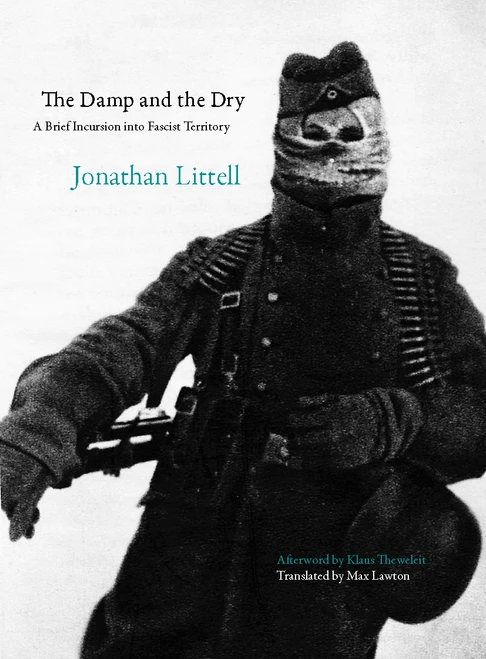



The Damp and the Dry
“This book solidifies Jonathan Littell's place as a premier interpreter of evil. The language of executioners that Littell describes is more relevant than ever in understanding the eruption of a neo-Fascist world.”
—Eyal Weizmanabout the bookabout
Léon Degrelle was Belgium’s highest-ranking Nazi collaborator and a fanatical Waffen-SS officer who fought on the Eastern Front during the Second World War. Admired by Hitler and Mussolini and later sheltered by Franco in Spain, Degrelle embodied the figure of the fascist true believer long after the defeat of the Third Reich.
In a richly illustrated text, Jonathan Littell here subjects Degrelle’s memoir, The Russian Campaign, to a forensic reading, bringing it into confrontation with the work of a renowned writer on psychology and fascism, Klaus Theweleit, who provides an afterword to the book. Littell dissects Degrelle’s prose to expose what he terms an “anatomy of fascist discourse”: a recurring set of metaphors, obsessions, and psychic structures through which fascist ideology understands the body, violence, purity, and the enemy.
The Damp and the Dry moves beyond biography to reveal how fascism thinks and speaks. It is a disturbing and incisive study of the authoritarian mentality—one that illuminates not only the history of twentieth-century fascism, but its enduring rhetorical and psychological appeal.
About The Author / Editor
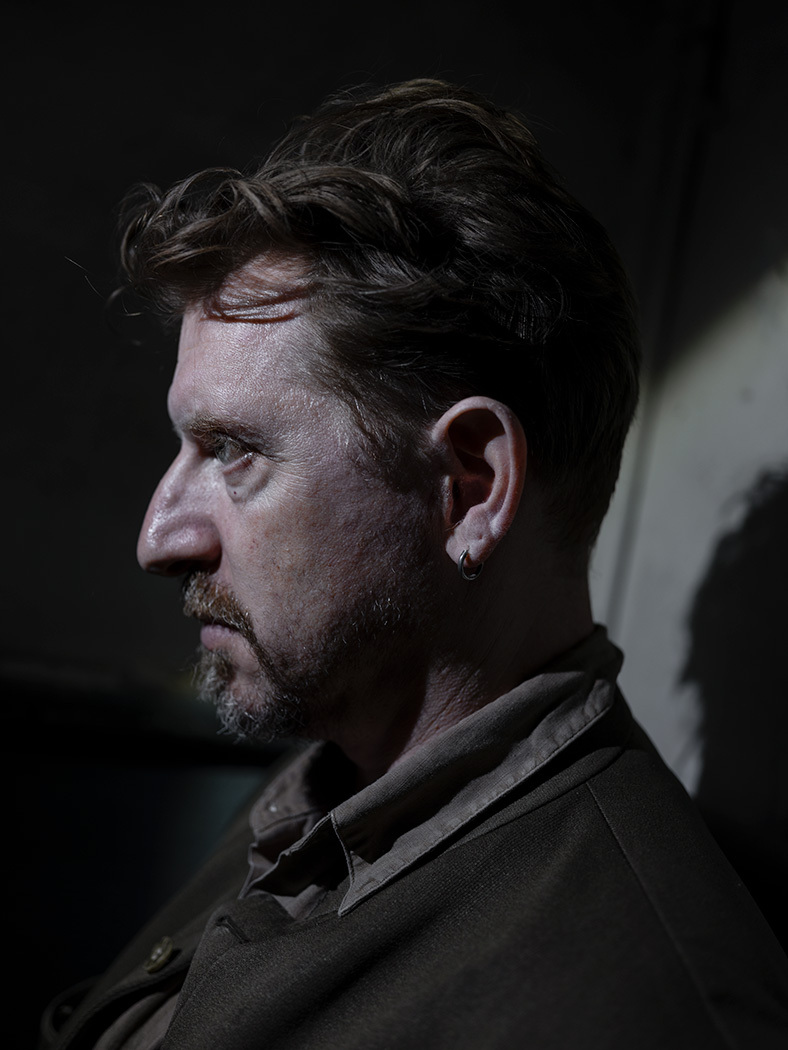
Klaus Theweleit is a German sociologist. He is best known for his two-volume study of the psychology of Nazism, Male Fantasies (University of Minnesota Press, 1987–89), first published in Germany as Männerphantasien in 1977–78.
Max Lawton is a translator of Russian, French, German, Spanish, Italian, and Turkish. He is the translator of eight novels by Vladimir Sorokin, including Telluria (New York Review Books Classics, 2022) and Their Four Hearts (Dalkey Archive Press, 2022).
Preview
WORDS
This book is actually not about Degrelle’s politics, but about his language. “[...] [L]et us say with true words what their epic struggle was, how they fought, how their bodies suffered, how their hearts offered themselves up,” he writes. Very well: let us look at what these true words truly tell us. As they are written.
“[...] [T]here is a specifically ‘fascist’ mode of producing reality [...] fascism is not a matter of form of government, or form of economy, or of a system in any sense,” writes Klaus Theweleit in his great 1977 book Male Fantasies. Theweleit, perhaps the first to do so, decided to take fascists at their word. Working on a corpus of around two hundred novels, memoirs, and journals written by veterans of the German Freikorps from 1918 to 1923, he attempted to analyze the mental structure of the fascist personality. Impossible to here summarize this brilliant, polymorphic, and elusive book; the most we can attempt is to sketch out its general conclusions.
For Theweleit, the fascist or “soldier male” (der soldatischer Mann) cannot be understood in terms of Freudian psychoanalysis, but must instead be approached through the psychoanalysis of childhood (Melanie Klein, Margaret Mahler) and of psychosis (Michael Balint and others), as well as through concepts inherited from Deleuze and Guattari. The Freudian model of Id, Ego, and Superego and, therefore, of the Oedipus Complex, cannot be applied to him, as the fascist has actually never achieved his separation from the mother and has never built himself an Ego in the Freudian sense of the term.
The fascist is he who is “not-yet-fully-born.” However, he isn’t a psychopath; he has effectuated a partial separation, he is socialized, he speaks, he writes, he acts in the world in a manner that, alas, is often effective, he even takes power sometimes. In order to achieve this, he has himself built or caused to be built—by way of discipline, training, and physical exercise—an externalized Ego that takes the shape of a “suit” of “muscle-armor.” This maintains all of his drives, his desiring functions, which are entirely formless as he is not capable of objectifying them, on the inside, where the fascist has no access. But this Ego-armor is never entirely hermetic, it is even fragile; it only holds up thanks to external supports: school, the army, even prison. In periods of crisis, it crumbles and the fascist then risks being overwhelmed by his uncontrollable desiring productions, the “dissolution of personal limits.”
To survive, he externalizes what threatens him internally, and, thus, for him all dangers take on two forms, which are intimately connected: that of the feminine and that of the liquid, of “all that which flows.” As the fascist cannot entirely annihilate womankind (he needs her in order to reproduce), he splits her into two figures: the White Nurse (or the Lady of the Manor), a virgin, of course, who generally dies or, in any case, is somehow petrified, unless the fascist marries her, in which case she just simply disappears from the text; and the Red Nurse (or Prostitute), whom the fascist, in order to maintain his Ego, kills, preferably by crushing her with the butt of his rifle, transforming her into a bloody pulp. As for the threat of the liquid, the fascist can either project it onto Bolshevism, in which case it returns in the form of the Red Tide, against which he erects the dike of his arms and of his (hard) body, or he can tame it, by, for example, making the crowd flow into the rigid channel of the National Socialist parade.
in the media
Related Interest
The Damp and the Dry
“This book solidifies Jonathan Littell's place as a premier interpreter of evil. The language of executioners that Littell describes is more relevant than ever in understanding the eruption of a neo-Fascist world.”
—Eyal Weizmanabout the bookabout
Léon Degrelle was Belgium’s highest-ranking Nazi collaborator and a fanatical Waffen-SS officer who fought on the Eastern Front during the Second World War. Admired by Hitler and Mussolini and later sheltered by Franco in Spain, Degrelle embodied the figure of the fascist true believer long after the defeat of the Third Reich.
In a richly illustrated text, Jonathan Littell here subjects Degrelle’s memoir, The Russian Campaign, to a forensic reading, bringing it into confrontation with the work of a renowned writer on psychology and fascism, Klaus Theweleit, who provides an afterword to the book. Littell dissects Degrelle’s prose to expose what he terms an “anatomy of fascist discourse”: a recurring set of metaphors, obsessions, and psychic structures through which fascist ideology understands the body, violence, purity, and the enemy.
The Damp and the Dry moves beyond biography to reveal how fascism thinks and speaks. It is a disturbing and incisive study of the authoritarian mentality—one that illuminates not only the history of twentieth-century fascism, but its enduring rhetorical and psychological appeal.
About The Author / Editor
Klaus Theweleit is a German sociologist. He is best known for his two-volume study of the psychology of Nazism, Male Fantasies (University of Minnesota Press, 1987–89), first published in Germany as Männerphantasien in 1977–78.
Max Lawton is a translator of Russian, French, German, Spanish, Italian, and Turkish. He is the translator of eight novels by Vladimir Sorokin, including Telluria (New York Review Books Classics, 2022) and Their Four Hearts (Dalkey Archive Press, 2022).
Preview
WORDS
This book is actually not about Degrelle’s politics, but about his language. “[...] [L]et us say with true words what their epic struggle was, how they fought, how their bodies suffered, how their hearts offered themselves up,” he writes. Very well: let us look at what these true words truly tell us. As they are written.
“[...] [T]here is a specifically ‘fascist’ mode of producing reality [...] fascism is not a matter of form of government, or form of economy, or of a system in any sense,” writes Klaus Theweleit in his great 1977 book Male Fantasies. Theweleit, perhaps the first to do so, decided to take fascists at their word. Working on a corpus of around two hundred novels, memoirs, and journals written by veterans of the German Freikorps from 1918 to 1923, he attempted to analyze the mental structure of the fascist personality. Impossible to here summarize this brilliant, polymorphic, and elusive book; the most we can attempt is to sketch out its general conclusions.
For Theweleit, the fascist or “soldier male” (der soldatischer Mann) cannot be understood in terms of Freudian psychoanalysis, but must instead be approached through the psychoanalysis of childhood (Melanie Klein, Margaret Mahler) and of psychosis (Michael Balint and others), as well as through concepts inherited from Deleuze and Guattari. The Freudian model of Id, Ego, and Superego and, therefore, of the Oedipus Complex, cannot be applied to him, as the fascist has actually never achieved his separation from the mother and has never built himself an Ego in the Freudian sense of the term.
The fascist is he who is “not-yet-fully-born.” However, he isn’t a psychopath; he has effectuated a partial separation, he is socialized, he speaks, he writes, he acts in the world in a manner that, alas, is often effective, he even takes power sometimes. In order to achieve this, he has himself built or caused to be built—by way of discipline, training, and physical exercise—an externalized Ego that takes the shape of a “suit” of “muscle-armor.” This maintains all of his drives, his desiring functions, which are entirely formless as he is not capable of objectifying them, on the inside, where the fascist has no access. But this Ego-armor is never entirely hermetic, it is even fragile; it only holds up thanks to external supports: school, the army, even prison. In periods of crisis, it crumbles and the fascist then risks being overwhelmed by his uncontrollable desiring productions, the “dissolution of personal limits.”
To survive, he externalizes what threatens him internally, and, thus, for him all dangers take on two forms, which are intimately connected: that of the feminine and that of the liquid, of “all that which flows.” As the fascist cannot entirely annihilate womankind (he needs her in order to reproduce), he splits her into two figures: the White Nurse (or the Lady of the Manor), a virgin, of course, who generally dies or, in any case, is somehow petrified, unless the fascist marries her, in which case she just simply disappears from the text; and the Red Nurse (or Prostitute), whom the fascist, in order to maintain his Ego, kills, preferably by crushing her with the butt of his rifle, transforming her into a bloody pulp. As for the threat of the liquid, the fascist can either project it onto Bolshevism, in which case it returns in the form of the Red Tide, against which he erects the dike of his arms and of his (hard) body, or he can tame it, by, for example, making the crowd flow into the rigid channel of the National Socialist parade.